
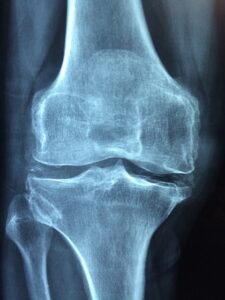
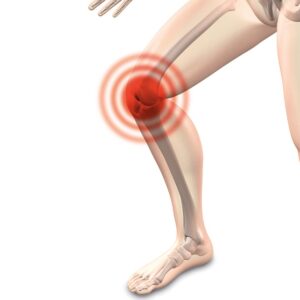
Knee pain is a very common symptom, injuries to the knee can vary from minor bumps and bruises to ligament or cartilage tears or even broken bones. When assessing knee pain we need to know when the pain started and if there was any trauma to the knee. The appearance of bruising and swelling and any instability (giving way of the knee) when walking is also important to consider as this can be a sign of ligament damage.
Muscle Strains
The quadriceps (front thigh), hamstring (back thigh) and calf muscles all have attachments around the knee, these muscles can be strained and can cause pain when contracting or stretching the muscle. Simple strains usually stop being painful after a few days to a few weeks. If the muscle is actually torn (bruising may have been seen after the injury) then this takes longer to heal up and recover, 6-8 weeks is the expected recovery time. Over tightness of the thigh muscles can lead to some pain developing around the knee cap, this often happens in runners and is not usually associated with a twist, fall or obvious injury. This pain is often referred to as patello femoral pain. These knee problems may need some rehabilitation in order to restore full pain free function and a member of the health bubble team can advise you on this.
Sprained and torn ligaments
Ligaments hold bones together to keep joints stable. These can be over stretched with various falls, twists and sliding injuries. If the ligaments are just sprained (stretched) the knee is likely to be painful but it won’t be likely to give way and it shouldn’t be too swollen. If the ligaments have been torn this creates a lot of swelling and the knee may be unstable and can give way when walking. The ligaments within the knee joint form a cross shape and are known as the cruciate ligaments (these are sometimes torn in football, contact sports, snow sports and some awkward falls). The ligaments on the inside and outside of the knee joint are called the collateral ligaments, these can also be sprained or torn. A simple sprain may not immediately need to be assessed but a suspected torn ligament in an obviously swollen knee needs to be examined by a healthcare professional because imaging (an x ray or MRI scan) of the knee may be needed.
Sometimes the kneecap (patella) can be dislocated from a sudden twist or a blow to the knee. People can often feel that the kneecap has “moved” and it can be very painful. These various injuries need rehabilitation in order to restore full pain free function and a member of the health bubble team can advise you on this.
Cartilage tears
The knee has some specialized cartilage called the meniscus on the inside and outside of the knee joint. The menisci act as a shock absorber inside the joint. The meniscus can be torn by sudden twisting injuries (football tackles, falls during running or snow sports etc). The knee will often swell up significantly within a few hours with a cartilage (meniscal) tear. In this situation the injured knee should be examined by a healthcare professional because imaging (an x ray or MRI scan) of the knee may be needed. These injuries need some rehabilitation in order to help restore full function and a member of the health bubble team can advise you on this.
Arthritis
The cartilage that lies on the surface of the bones (articular cartilage) that allows the smooth gliding of the joint can develop some wear over time. This can cause stiffness and pain and this process is known as osteoarthritis (what most people refer to as arthritis in day to day language). A combination of advice, painkillers and specific exercise can assist with this type of knee pain. If the arthritis is very severe some patients may be offered a knee replacement. A member of the health bubble team can advise you further on the treatments for this type of knee pain.
Bursitis and Gout
These are causes of red, hot swollen knees that come on without and injury or damage to the knee. A bursa is a fluid filled sac designed to reduce friction around different tissues as they move, sometimes they can become swollen, hot and painful. Some people are prone to gout and this can occur in the knee. This is when crystals can be deposited within a joint and this can bring on a lot of pain and swelling. Medications can help with these problems.
Blood clots (DVTs VTEs)
If there is a sudden onset of pain in the back of the calf or knee (without an injury) which is followed by redness, heat and swelling around the knee this may be the signs of a blood clot (known as a D.V.T or V.T.E). Being dehydrated, long flights (or prolonged periods without moving) and having had past blood clots are all risk factors for developing a D.V.T. A suspected blood clot needs urgent medical attention (usually at the A&E department in a hospital).
Osgood-Schlatters
This condition is a common reason for pain just below the front of the knee in children. This is an overuse problem that tends to develop in active children (aged 9-14) who do lots of running and jumping. The tendons muscles and growth plates of the bone all grow and develop at different rates. In this condition the tendon connecting the kneecap to the shin bone (patella tendon) irritates the growth plate region of the shin bone. Ice, paracetamol and activity modification can help with this problem.
If you need advice, rehabilitation or treatment for a knee problem feel free to contact us at Byfleet Chiropractic. You can find more helpful information using the links below:
https://www.nhs.uk/conditions/knee-pain/
https://www.versusarthritis.org/about-arthritis/conditions/knee-pain/